


How to Choose a Soldering Station
A practical guide to picking the right soldering station for your work — from occasional repairs to full production benches. Written by the Grove Sales technical team.
In this guide
1.Why the right station matters
A soldering station is the single most-used tool on any electronics bench, and the wrong one costs you in poor joints, damaged boards and wasted time. The key difference between a cheap iron and a proper station is temperature control: a controlled station holds the tip at a precise, stable temperature and recovers heat quickly between joints. An uncontrolled mains iron simply gets hotter and hotter, making reliable, repeatable joints almost impossible and putting your boards at risk.
This guide walks through what actually matters when choosing a station, then points you to the right range for your type of work.
2.The 8 factors that matter
2.1Temperature control & stability
Non-negotiable for any PCB work. Look for closed-loop temperature control with a clear digital readout and fast, accurate regulation. Stability under load — how well the tip holds temperature as you make a joint — matters more than the headline maximum temperature.
2.2Power & thermal recovery
Power (wattage) determines how quickly the tip recovers heat after each joint. Higher power isn't about running hotter — it's about maintaining temperature when soldering large pads, ground planes or connectors with high thermal mass. Entry stations of 50–70 W suit general PCB work; 90 W and above is better for lead-free and heavier joints.
2.3Tip range & ecosystem
The handpiece and its tips do the real work. Check the breadth of tip shapes and sizes available for the iron, and that genuine replacement tips are easy to source — the tip is a consumable and you'll buy many over a station's life. Sticking to a well-supported ecosystem such as Weller or Quick protects your investment.
2.4Single-tool or multi-tool
A single-tool station drives one iron. A multi-tool station powers several handpieces at once — for example an iron plus hot tweezers, a desoldering gun or a hot air pencil — which is ideal for a busy bench doing varied work. If you regularly switch between soldering, rework and desoldering, a multi-tool platform saves time and bench space.
2.5Soldering vs rework & desoldering
If you only assemble or repair through-hole and simple SMD, a soldering iron is enough. If you remove SMD, SOIC or QFP packages, you'll also want hot air rework and/or a desoldering tool. Decide now whether your bench needs rework capability — it's cheaper to buy a station that supports it than to replace one that doesn't.
2.6Lead-free readiness
Lead-free alloys such as SAC305 melt hotter than leaded solder and demand more from a station — higher tip temperatures and better thermal recovery. If your work is (or will be) RoHS/lead-free, choose a station with the power and tip range to handle it comfortably rather than one running at its limit.
2.7ESD safety
Any work on static-sensitive electronics should be done with an ESD-safe station on a properly grounded bench. Professional and production stations are ESD-safe by design and bond to your common ground point. If in doubt, treat ESD safety as essential — the damage it prevents is invisible until it isn't. See our ESD protection guide for setting up a compliant bench.
2.8Smart features & traceability
Higher-end platforms such as the Weller WXsmart add process control, tip-temperature verification and data logging — valuable where you need repeatable, documented results for ISO 9001 or customer quality requirements. For a single hobby bench these features are optional; for a production line they can be a requirement.
3.Which station for which job
| Your use | What you need | Where to look |
|---|---|---|
| Occasional / education / hobby | Temperature control, ESD-safe, a couple of tip shapes, simple to use | Weller WE entry stations |
| Professional repair / service bench | Strong thermal recovery, wide tip range, lead-free capable, room to add hot air | Weller WT / WX single-tool + hot air rework |
| High-throughput / production / multi-process | Multi-tool (iron + tweezers + desolder + hot air), smart process control & logging | Weller WX / WXsmart, Quick rework stations |
4.The ranges we stock
- Weller WE — reliable, affordable entry stations for general and educational use.
- Weller WT — versatile mid-range single-tool stations for professional benches.
- Weller WX — high-power professional platform, single or multi-tool, with a huge tip range.
- Weller WXsmart — the smart, connected flagship: multi-tool, process control and data logging for production and quality-critical work.
- Quick — soldering, desoldering and hot air rework stations, strong value for rework-heavy benches.
Not sure which fits your bench? Call us on 01202 588900 — we'll talk it through and recommend the right setup, with trade pricing for workshops and OEMs.
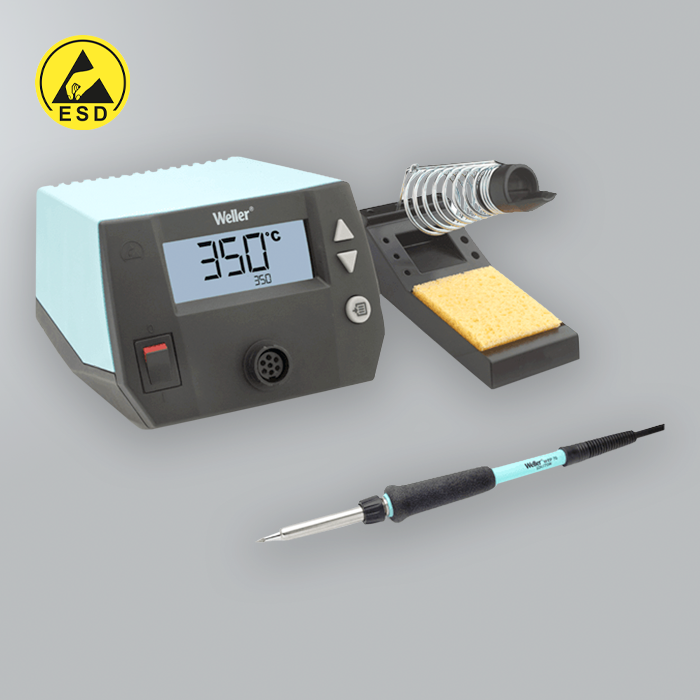
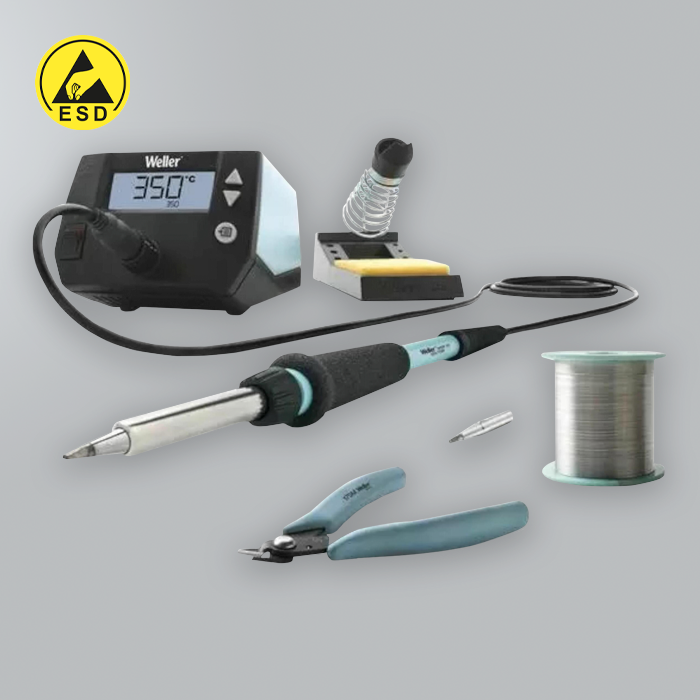
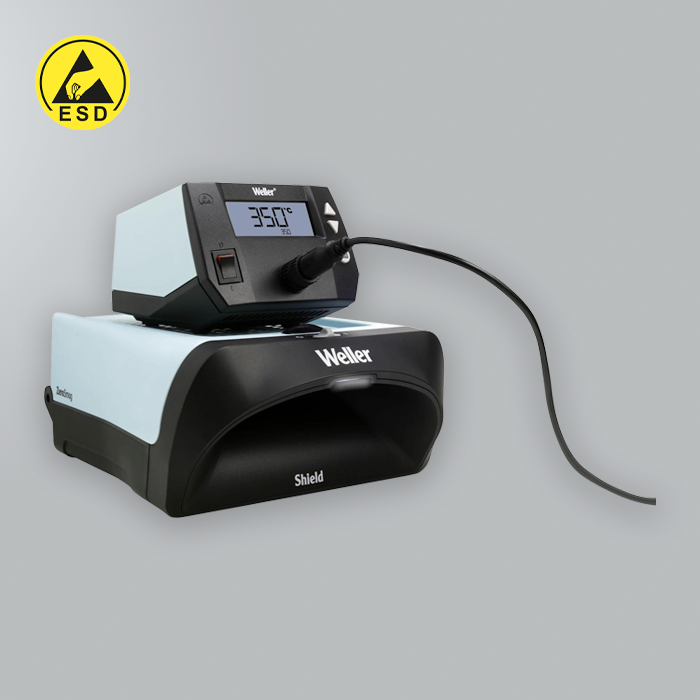
Popular soldering stations
5.Build a complete station kit — in minutes
Once you know which platform suits your bench, our Weller Kit Builder assembles the whole setup for you. Start from a bare Weller control unit, add a compatible iron, load the tips you need, drop in the correct safety rest, and finish with your consumables — solder, flux and a tip cleaner. It only ever offers parts that genuinely fit the unit and iron you have picked, shows a live running total, and adds the complete kit to your basket in one go.
It also does the thinking for you: it recommends the correct safety rest for each handpiece, and if the items you have chosen are cheaper as an official Weller set, it flags the saving automatically — so you never pay more than you need to.
6.Common questions
What temperature should I solder at?
Typically 320–360 °C for leaded solder and 340–380 °C for lead-free. Use the lowest temperature that gives a clean, quick joint — running hotter than necessary shortens tip life and risks board damage.
Do I really need an ESD-safe station?
For any static-sensitive electronics, yes. ESD damage is often latent — the board works today and fails weeks later. An ESD-safe station on a grounded bench is cheap insurance.
Does lead-free need a more powerful station?
Yes. Lead-free melts hotter and pulls more heat from the tip, so a station with good power and thermal recovery makes lead-free work far easier.
Are genuine tips worth it?
Yes. Genuine Weller and Quick tips transfer heat better and last significantly longer than cheap copies, which usually works out cheaper per joint.