


What Is ESD and How Do You Control It?
Electrostatic discharge is the shock you get from a car door on a dry day. On a production bench the same event, far too small to feel, can destroy a component outright or leave a fault that surfaces months later in the field. This guide explains where static comes from, what it does to electronics, and the controls that an Electrostatic Protected Area is built on.
In this guide
1.Static electricity in one minute
Every material is made of atoms with positively charged protons and negatively charged electrons, normally in balance. When two materials touch and separate, electrons move from one to the other. This is triboelectric charging, and if the material cannot conduct the charge away it sits there as static electricity. Insulators such as plastics, synthetic fabrics and untreated packaging hold charge well, which is exactly why they cause trouble around electronics.
How much charge builds up depends on the materials, how hard and how often they rub, the contact area and the humidity. Dry air lets charge accumulate, so static problems are worse in winter and in air-conditioned buildings.
2.What electrostatic discharge is
Electrostatic discharge (ESD) is the sudden flow of that stored charge between two objects at different potentials. Everyday actions generate it all the time:
- walking across synthetic flooring or carpet
- taking off a fleece or rubbing a synthetic sleeve on a bench
- sliding a plastic tote or picking up a bubble-wrapped board
- unrolling ordinary adhesive tape
- components moving along a conveyor or in an untreated tray
A person feels a discharge at roughly 3,000 volts and sees a spark at around 5,000. Many electronic components are damaged by less than 100 volts, so most damaging ESD events are never noticed by the person who caused them.
3.Why a shock you cannot feel matters
ESD damage comes in two forms, and the second is the expensive one.
Catastrophic failure is immediate and permanent: a gate oxide punctured or a junction melted, and the device is dead. These failures are usually caught by test before shipping, so the cost is scrap and rework.
Latent defects are the quiet ones. The device is wounded but still passes test. It ships, works for a while, then fails early in service, often at the worst moment and with no obvious cause. Latent damage is hard to detect, impossible to screen out completely, and lands as warranty returns, field repairs and reputation damage long after the event.
Damage can happen at any stage: component handling, board assembly, inspection, rework, packing, transport and service in the field. Industry estimates of annual ESD losses run to billions, which is why every serious electronics operation runs a formal control programme.
4.Who is at risk
- Electronics manufacturing and repair: integrated circuits, MOSFETs, LEDs and sensors are all ESD-sensitive, and modern geometries are getting more so.
- Aerospace, automotive and medical: a latent defect in a safety-critical assembly can have consequences far beyond its price.
- Laboratories and anywhere with flammable vapours: a spark is an ignition source.
- Cleanrooms and optics: charged surfaces attract particles, so static is also a contamination problem.
5.The four golden rules of ESD control
- Treat every electronic component as ESD-sensitive unless you know otherwise.
- Handle sensitive items only inside an Electrostatic Protected Area, by people who are grounded.
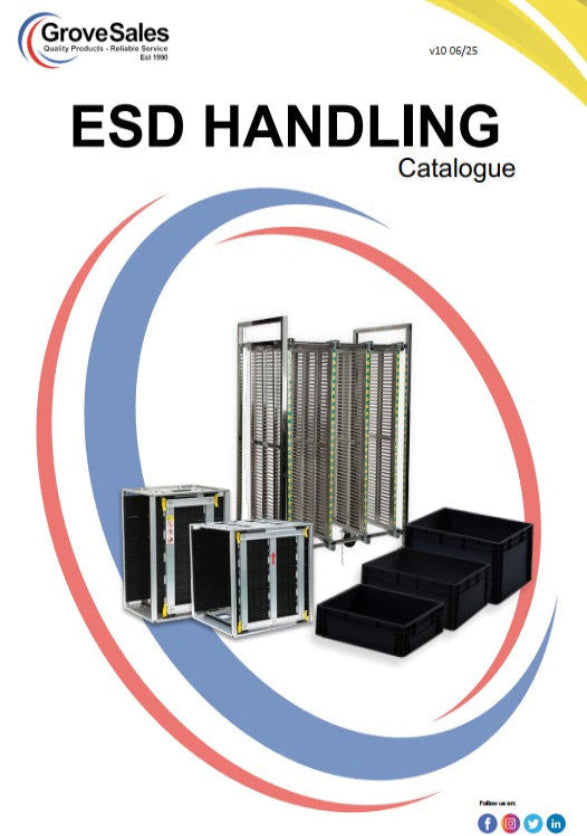
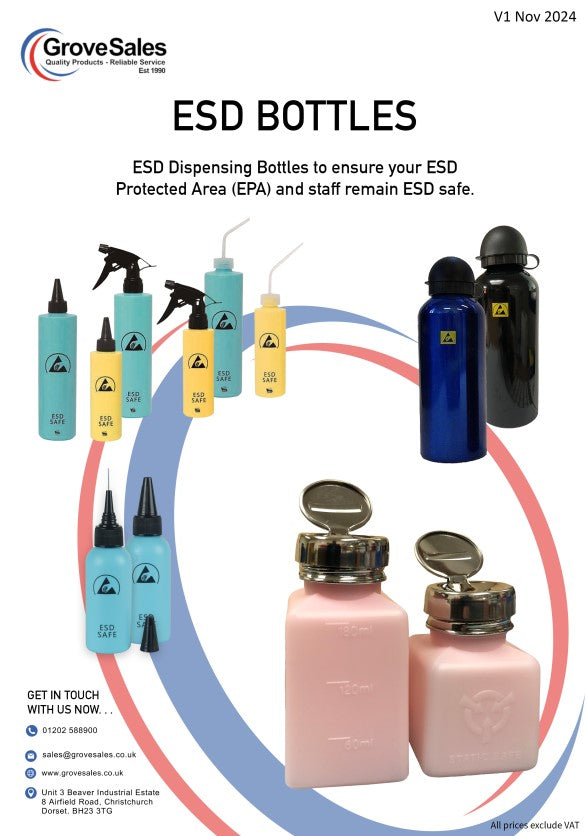
- Store and move sensitive items in ESD packaging: shielding bags, dissipative bins and containers, never ordinary plastic.
- Test and audit the controls, both your own and your suppliers', and keep the records.
6.What an Electrostatic Protected Area contains
An EPA is a defined area where everything, people included, is kept at the same potential so that no damaging discharge can occur. To BS EN IEC 61340-5-1 it needs:
- clear boundary markings and signage at every entry point
- grounded, static-dissipative work surfaces and bench matting
- a ground path for every person: wrist straps when seated, ESD footwear or heel grounders on dissipative flooring when mobile
- static control garments to cover charge-generating everyday clothing
- ESD packaging: shielding bags and dissipative containers for anything that leaves the area
- earth bonding points for mats, straps and equipment
- ionisers where insulators that cannot be removed, such as PCB laminate or product housings, must be neutralised
- testers and a routine for using them, plus training for everyone who enters
7.Where to start
If you are setting up from scratch, read Which ESD Protection Does My Workbench Need? for a bench-by-bench shopping list and How to Choose & Set Up an ESD Workbench for the furniture. Two common gaps in otherwise good EPAs are clothing and testing: why a wrist strap does not ground your clothes, and what to test and how often. Grove Sales has supplied ESD control to UK electronics manufacturers since 1990; call 01202 588900 if you would like us to look at your area.