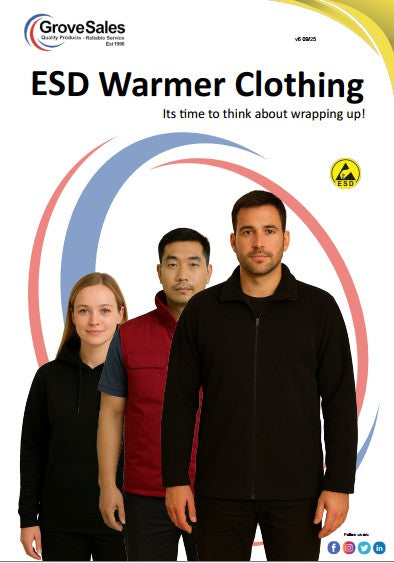



Why Wear an ESD Lab Coat or Jacket?
A common question on the shop floor: why wear an ESD coat when I am already grounded through a wrist strap? Because the strap grounds you and not your clothes. Synthetic clothing generates and holds charge that no wrist strap can drain, and the field it carries can damage a board without anything touching it. This guide covers what an ESD garment does, what the standard asks of it, and how to wear, ground, test and wash one.
In this guide
1.The wrist-strap misconception
A wrist strap with its 1 MΩ cord gives your skin a safe path to earth, so the charge on your body is drained. It does nothing for the fleece, polyester shirt or nylon jacket you are wearing. Those fabrics are insulators: they generate charge as you move and they keep it, because there is no conductive path from the fabric to the strap.
That charge is not harmless just because it is on cloth. A charged sleeve or shirt front can carry several thousand volts, and a charged insulator held near a conductor induces a charge on the conductor. Lean over a board with a charged sleeve and the board sees a field; touch a pin and the induced charge discharges. ESD lab coats and jackets exist to put a dissipative, grounded layer over the insulating clothing so that field never reaches the work.
2.What an ESD garment does
A static control garment is woven with a grid of conductive fibre, usually carbon-loaded, running through a polyester-cotton base. The grid gives the garment four properties:
- Low charging: the fabric generates far less charge than ordinary cloth when it rubs.
- Dissipative: any charge that does build up spreads across the grid and drains to ground once the garment is grounded.
- Shielding: the grid acts as a partial Faraday cage, keeping the field from the clothing underneath inside the garment.
- Groundable: conductive cuffs, and on some styles a waist snap, connect the grid to the wearer and so to earth.
GTEK garments hold surface resistance in the 106 to 108 Ω range with volume resistance below 107 Ω, which keeps them dissipating continuously through the working day rather than charging up and discharging in bursts.
3.What the standard asks for
BS EN IEC 61340-5-1 does not make a coat compulsory in every EPA, but where garments are part of your ESD control programme, and in practice they always should be, it sets three categories:
- Static control garment: point-to-point resistance across the fabric below 1 × 10¹¹ Ω. The garment covers clothing and limits fields.
- Groundable static control garment: below 1 × 10⁹ Ω from any point to the groundable point, so the garment itself can be bonded to earth.
- Groundable static control garment system: below 3.5 × 10⁷ Ω measured through the garment and the person together, used where the garment is the person's primary ground path.
Panel-to-panel continuity matters: every panel, sleeve and the cuffs must be electrically connected, otherwise a sleeve becomes an isolated conductor that can charge on its own. That is the first thing to check when a garment arrives and after it has been altered or repaired.
4.Wearing and grounding it correctly
- Fasten it. An open coat exposes the clothing it is supposed to cover. Do up every popper or button.
- Cuffs on skin. The conductive cuff is the ground connection. It must touch your wrist directly, never sit over a shirt sleeve, and sleeves should not be rolled up.
- Ground it one of three ways: a wrist strap worn under the cuff, so skin, cuff and strap are all in contact; a coiled grounding cord clipped to the garment's waist snap where fitted; or, when standing and moving, ESD footwear or heel grounders on dissipative flooring, with the cuffs providing the path from garment to person.
- Do not alter it. Shortening sleeves or taking in panels can cut the grid. Shrinkage of around 5% over the garment's life is normal and does not affect performance.
5.Testing a garment
Two checks cover almost everything. A resistance test between panels, sleeve to sleeve and sleeve to body, with a surface resistance meter and two electrodes confirms the grid is continuous and within the limits above. A static field meter held near the fabric after it has been rubbed shows whether the garment is still low-charging; a worn-out or wrongly laundered coat charges like ordinary cloth. Test on receipt, after any repair and periodically through the garment's life, and keep the readings with your other ESD records.
Our Surface Resistance Meter and Surface Resistivity Kit cover the resistance checks; see ESD Testing Equipment: What to Test and How Often for the full testing routine.
6.Washing and care
Laundering is where most ESD garments are ruined. Fabric softener coats the conductive fibres, bleach attacks them, and heat shrinks and breaks the grid. The care rules for GTEK garments are:
- Wash at 40°C or cooler in a neutral liquid detergent.
- No bleach, chlorine, fabric softener or any alkaline or acidic additive.
- Do not dry clean.
- Line dry, or tumble dry at up to 50°C.
- Ironing is not needed; if you do, keep it at or below 110°C.
- For a fleet of garments, use an industrial laundry that offers a documented, controlled ESD washing process.
Re-test a sample after the first few washes to confirm your laundry is not degrading them.
7.Choosing a coat or jacket
Lab coat or jacket? A coat covers to the knee and suits seated bench work and cleanrooms; a jacket stops at the hip and is easier to move in on a line. Short-sleeve jackets suit warm areas but leave forearms exposed, so pair them with sleeves rolled down underneath or accept the trade-off.
Standard, Premium or Heavy Duty. Standard is the cost-effective everyday garment for larger teams. Premium is a heavier fabric with better dissipative performance and durability under frequent industrial laundering. Heavy Duty adds weight again for the hardest wear. All are unisex, certified to IEC 61340-5-1, and available in several colours, which many sites use to tell departments or visitor status apart at a glance.
All GTEK garments can be embroidered with your company logo through our embroidery service.