


Which Donaldson BOFA Fume Extractor Do I Need?
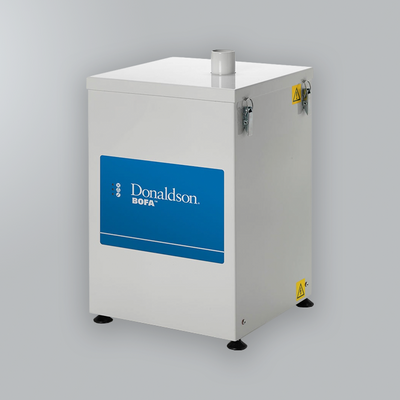
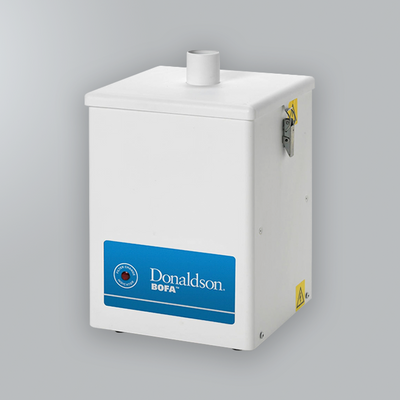
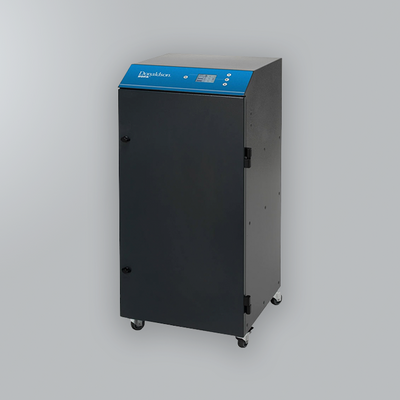
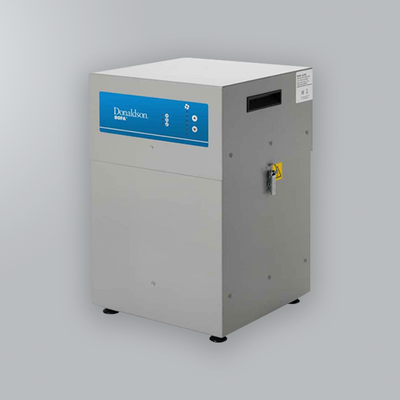
Donaldson BOFA makes extraction for almost every process that puts fume or dust into the air. The trick to choosing is to start with the process, not the model number. This guide works through hand soldering, laser marking and engraving, mechanical dust and the specialist units, then covers filters, arms and the LEV testing that keeps it all legal.
In this guide
Grove Sales is an authorised Donaldson BOFA distributor, so everything in this guide is stocked with genuine filters to match. Browse the full range at ALL Donaldson BOFA Products or the Donaldson BOFA fume extraction overview.
1.Hand soldering: tip extraction or arm extraction?
There are two ways to capture solder fume at a bench. Tip extraction draws fume through a small tube fixed to the soldering iron itself, so the capture point is a few millimetres from the joint. Arm extraction uses a flexible arm with a nozzle or funnel positioned over the work, which suits irons without a tip-extraction fitting and any job where the operator moves around. Both meet the requirement to capture fume at source; general ventilation does not.
For tip extraction the BOFA T15 is the standard choice. Its high-vacuum pumps serve up to 15 operators or extraction points, it has three-stage filtration including 99.97% HEPA, and a built-in silencer keeps it quiet enough to sit under the bench. It also runs vac pens and micro-extraction heads.
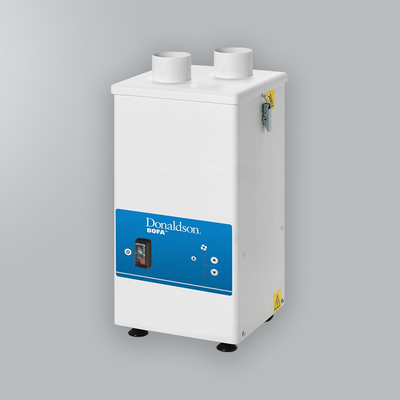
For one or two benches with arms, the V200 and V250 are the workhorses. The V200 is supplied as a single-arm kit and the V250 as a dual-arm kit for two operators, each with unit-mounted stay-put arms, 99.97% HEPA filtration, a granulated carbon gas stage and a filter-blocked indicator. At 420 by 290 by 270 mm they move with the bench when the production layout changes. The V250 is also available with a double gas filter for gas-heavy fume, or with an MEK filter where solvent cleaning is part of the process.
For a row of benches, step up to the volume units. The V600 serves one to seven operators depending on the capture device, with a filter condition display, digital speed control and built-in silencing. The V Oracle iQ adds BOFA's Intelligent Operating System and a DeepPleat DUO pre-filter for high-volume soldering, and the V 1000 iQ is the heavy-duty option: up to 15 operators, or the fume from automated soldering machines.
Where a process needs enclosing, the FumeCAB 600 and FumeCAB 1000 iQ cabinets give a lit, contained working area with their own extraction; the 600 comes with two 1.5 m lengths of 75 mm hose and an LED strip.
2.Laser marking, coding and engraving
Laser fume is the AD range. Pick by duty and by what sits on the laser bed.
Light duty, such as a school laser cutter, a sign-maker's workshop or occasional coding: the AD Access is the compact, low-cost entry point with three-stage filtration and a filter condition indicator, and the AD 350 is the light-duty marking and engraving unit with low noise and easy maintenance.
Light to medium industrial coding: the AD Nano and AD Nano+ bring reverse-flow air technology and DeepPleat DUO filtration in a stainless steel case for small-scale production.
Industrial use: the AD Oracle iQ is the benchmark, with the iQ system capturing and downloading performance data, and the AD Oracle SA iQ is the lighter-use version with a smaller pre-filter and a 115 to 230 V supply.
Heavy duty, with large volumes of particulate and organic compounds: the AD 500 iQ, AD 1000 iQ and AD 1500 iQ, the last moving 1,250 m³/h at 100 mbar, and at the top the AD 2000 iQ with dual filters that hold airflow steady as the filters load.
Desktop lasers: the AD Base 1 Oracle and AD Base 2 Oracle are two-in-one units that double as the workstation, with the engraver sitting on top. The Base 2 sits lower for larger-bed machines. Both have auto-voltage sensing, reverse-flow filtration with automatic flow control and an optional onboard compressor.
For heavy particulate ahead of any AD unit, the AD Cyclone and ILF inline filters extend main filter life, and the FireBOX is a self-extinguishing inline pre-filter for added fire protection.
3.Mechanical dust: routing, engraving, grinding, CNC
The DustPRO units handle swarf and fine particulate rather than fume. The DustPRO 50 has a 50 mm inlet for a single machine, the DustPRO 250 and the stand-alone DustPRO Universal cover routing, mechanical engraving, grinding and turning, and the DustPRO 400 adds more airflow with a brushless blower, adjustable speed, a bag pre-filter and a HEPA stage rated at 99.995% at 0.3 microns, with optional remote start and filter alerts. For a mobile arm-based unit the FumeKART takes 75 or 100 mm arms and a choice of 350, 385 or 500 mm hoods.
4.Other processes
BOFA also makes units and filters for 3D printing (the 3D PrintPRO range shares filters with the V200 and V250), dental laboratories (DentalPRO Base) and printing. See the Donaldson BOFA additive manufacturing page, the dental extraction units and the printing filters, or ask us.
5.Filters: how the three stages work and when to change them
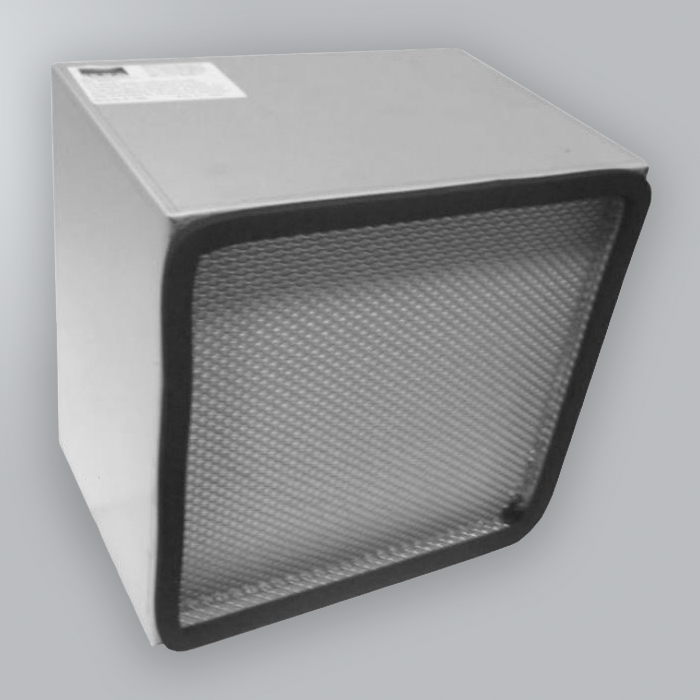
Every BOFA unit filters in stages. A pre-filter catches the larger particles first; the DeepPleat and DeepPleat DUO pre-filters pack a large media area into a cardboard case, 6 m² in the FumeKART version, rated F8 at 95% efficiency for 0.9 micron particles, and exist purely to make the expensive main filter last longer. The main stage is the combined HEPA/gas filter: pleated glass-fibre HEPA removing 99.97% of particles at 0.3 microns, or 99.997% in the laser and FumeCAB 1000 iQ filters, bonded to treated activated carbon that absorbs the gases and vapours, with 15 kg of carbon in the AD Oracle filter and 26 kg in the FumeCAB 1000 iQ.
There is no fixed change interval, because filter life depends on what you extract and how much. Change the pre-filter when the unit's filter condition indicator calls for it, and the combined filter when the indicator or the iQ display reports it. Changing the pre-filter on time is the cheapest way to protect the main filter. Each unit's product page lists its compatible filters under “Compatible with”, and genuine BOFA filters keep the unit within its LEV certification.
6.What iQ means
Units badged iQ run BOFA's Intelligent Operating System. The display gives operators real-time performance information, the unit logs data that can be downloaded for evaluation, filter alerts are precise rather than guessed, and on the larger units the system maintains airflow as the filters fill. If you need to prove your extraction is performing, iQ is the range to choose.
7.Arms, nozzles and pipework
Arm extraction depends on the capture end. BOFA ESD stay-put arms come in 32, 50 and 75 mm diameters, unit-mounted or on a benchtop bracket, in 1 m and 1.4 m lengths, with a choice of nozzle, funnel, slot or plenum ends and an LED-lit version for inspection work. For fixed installations we stock the hoses, reducers, cowls and pipework to run from unit to bench.
8.LEV testing and compliance
Under COSHH, extraction that controls a hazardous substance is local exhaust ventilation and must be examined and tested at least every 14 months. Grove Sales provides LEV examination and testing on all BOFA equipment, so the unit you buy can be certified and stay certified.
9.Quick chooser
| Process | Start with |
|---|---|
| Hand soldering, irons with tip extraction, 1 to 15 operators | T15 |
| One bench with an arm | V200 |
| Two benches | V250 dual arm |
| Three to seven benches | V600 |
| Production line or machine soldering | V Oracle iQ or V 1000 iQ |
| Light laser work | AD Access or AD 350 |
| Industrial laser | AD Oracle iQ, or AD Oracle SA iQ for lighter use |
| Heavy laser duty | AD 500 iQ to AD 2000 iQ |
| Desktop laser | AD Base 1 or AD Base 2 |
| Lasering PVC | AD PVC iQ |
| Routing, engraving and grinding dust | DustPRO |
| An enclosed process | FumeCAB |